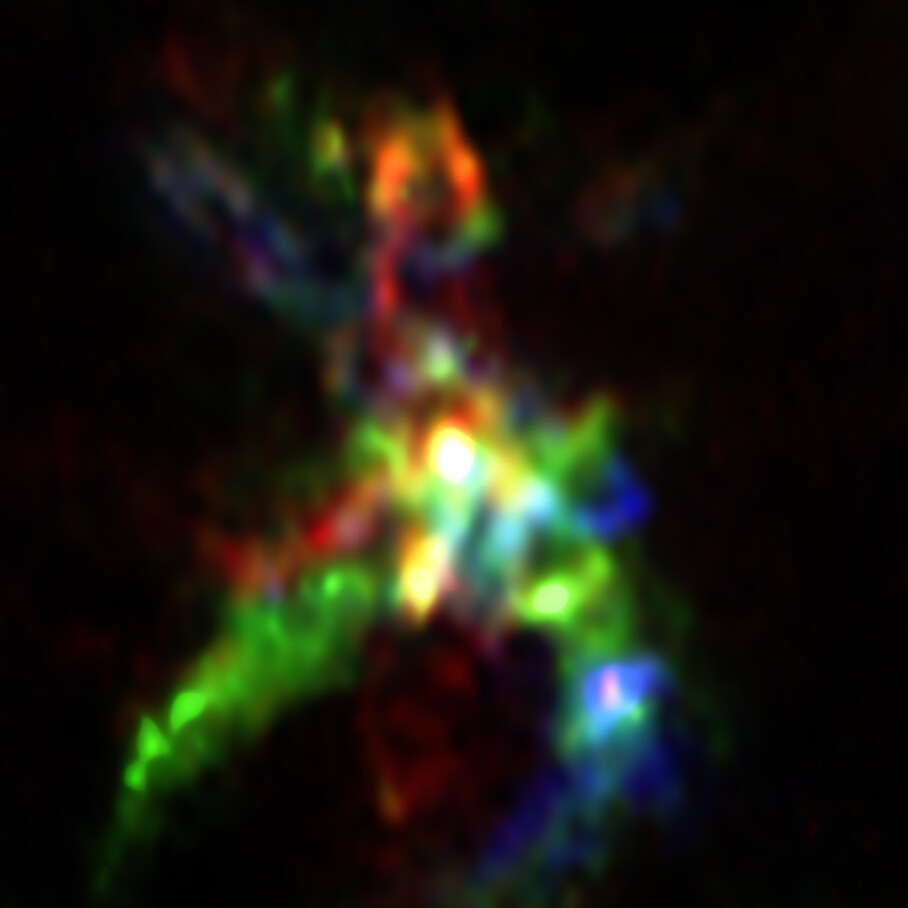
Submillimetre image of AFGL5142 taken using the Atacama Large Millimeter/submillimeter Array (ALMA). Credit: ALMA (ESO/NAOJ/NRAO), Rivilla et al.
Background and Motivation
Understanding the formation of massive stars is one of the key challenges in modern astrophysics. Because these stars form in dense, obscured regions, we rely on radio observations of masers — naturally occurring “cosmic lasers” — to trace the complex motions of gas within protostellar outflows. Traditionally, astronomers measure the 3D motions of these water masers to calculate the inclination, velocity, and dynamical history of the jets driven by young stars. A fundamental assumption in these studies has been that the maser spots move at the same velocity as the shock surfaces (bow shocks) they reside in (Goddi et al., 2005). This project aimed to rigorously test that assumption.
Methodology
We focused our study on AFGL 5142-MM1, a high-mass protostar with a mass of \(6.5~\mathrm{M}_{\odot}\) known for its distinct outflow features (Burns et al., 2017). We combined seven epochs of archival data from the VERA (VLBI Exploration of Radio Astrometry) array (collected between 2014 and 2015) with new, high-sensitivity observations from the KaVA (KVN and VERA Array) network conducted in 2016 (Rosli et al., 2023). By tracking specific maser features over several years, we measured their positions and compared their motions to the expected trajectories of the bow shock surfaces.
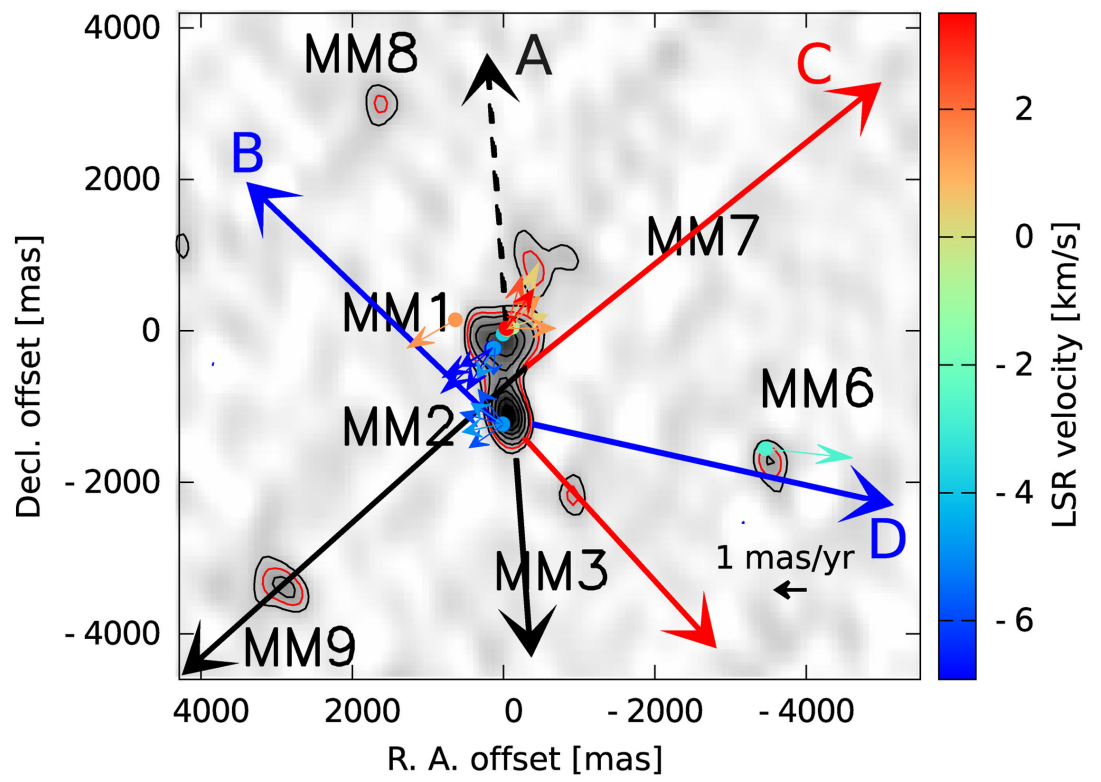
3D water maser velocities in AFGL5142 taken using VERA in 2015
Key Findings
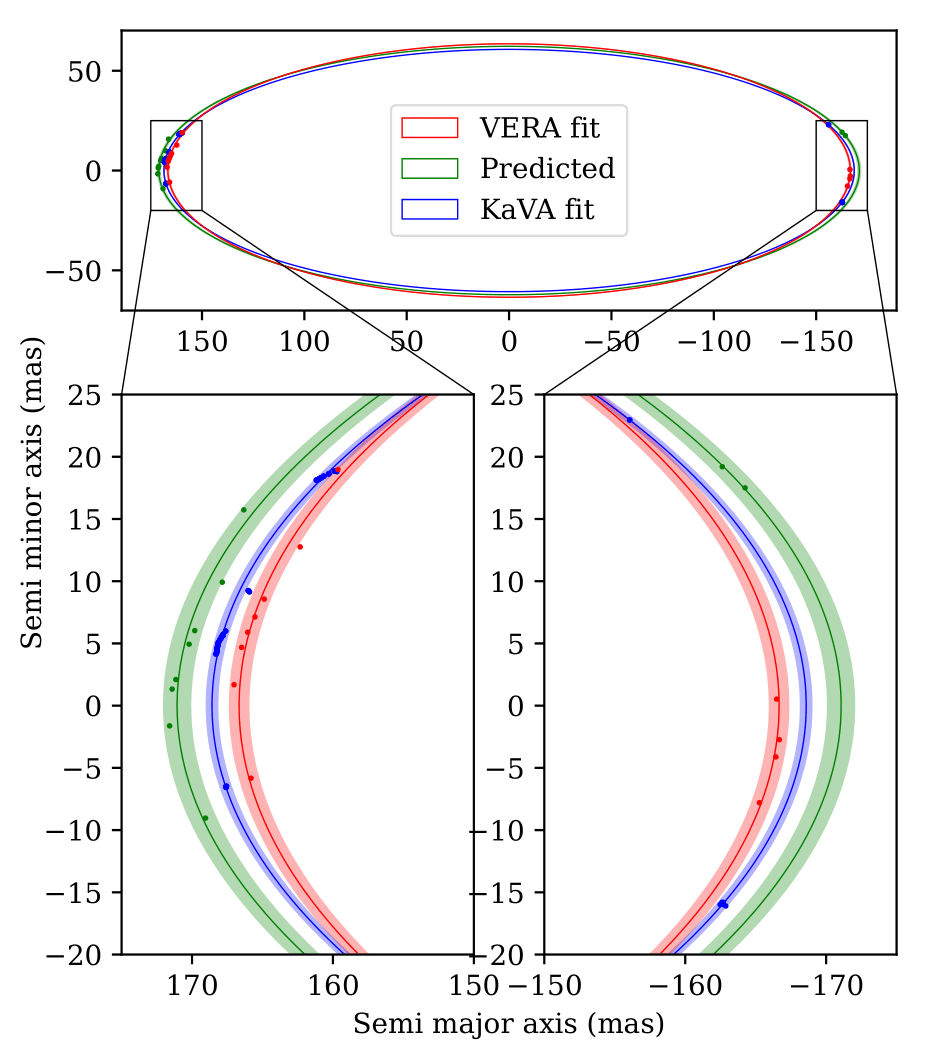
Our analysis revealed that the bow shocks do not move as far as the extrapolation predicted. We propose that discrepencies may exist between the motions of the masers and the motions of the bowshocks, either due to relative motions of the shock and the maser cloudlets, supersonic turbulence, or on an extreme, the deceleration of the shock itself.
Evolution of protostellar bowshocks in AFGL5142-MM1
Implications
These results serve as a cautionary note for the astronomical community. They demonstrate that water masers and shock surfaces can move relative to one another, meaning that interpretations of protostellar outflows based solely on short-term maser motions may not accurately reflect the long-term evolution of the system. Our work emphasizes that while short-term, high-cadence monitoring is best for studying gas clumps, long-term monitoring is essential for understanding the true evolution of shock surfaces in massive star-forming regions.
References
Kinematics of H\(_2\)O
masers in high-mass star forming regions
C. Goddi, L. Moscadelli, W. Alef, A. Tarchi, J. Brand, ...
Multi-epoch very long baseline interferometry (VLBI) observations
measure three-dimensional water maser motions in protostellar outflows,
enabling analysis of inclination and velocity. However, these analyses
assume that water masers and shock surfaces within outflows are
co-propagating. We compare VLBI data on maser-traced bow shocks in the
high-mass protostar AFGL 5142-MM1, from seven epochs of archival data
from the VLBI Exploration of Radio Astrometry (VERA), obtained from 2014
April to 2015 May, and our newly conducted data from the KVN and VERA
Array (KaVA), obtained in 2016 March. We find an inconsistency between
the expected displacement of the bow shocks and the motions of
individual masers. The separation between two opposing bow shocks in
AFGL 5142-MM1 was determined to be \(337.17
\pm 0.07~\mathrm{mas}\) in the KaVA data, which is less than an
expected value of \(342.1 \pm
0.7~\mathrm{mas}\) based on extrapolation of the proper motions
of individual maser features measured by VERA. Our measurements imply
that the bow shock propagates at a velocity of \(24 \pm 3~\mathrm{km}~\mathrm{s}^{-1}\),
while the individual masing gas clumps move at an average velocity of
\(55 \pm
5~\mathrm{km}~\mathrm{s}^{-1}\); that is, the water masers are
moving in the outflow direction at double the speed at which the bow
shocks are propagating. Our results emphasize that investigations of
individual maser features are best approached using short-term
high-cadence VLBI monitoring, while long-term monitoring on timescales
comparable to the lifetimes of maser features is better suited to
tracing the overall evolution of shock surfaces. Observers should be
aware that masers and shock surfaces can move relative to each other,
and that this can affect the interpretation of protostellar
outflows.
@article{Rosli2023,title={Limits of water maser kinematics: Insights from the high-mass protostar {AFGL~5142-MM1}},volume={527},issn={1365-2966},url={http://dx.doi.org/10.1093/mnras/stad3767},doi={10.1093/mnras/stad3767},number={4},journal={Monthly Notices of the Royal Astronomical Society},publisher={Oxford University Press (OUP)},author={Rosli, Zulfazli and Burns, Ross A. and Nazri, Affan Adly and Sugiyama, Koichiro and Hirota, Tomoya and Kim, Kee-Tae and Yonekura, Yoshinori and Tie, Liu and Orosz, Gabor and Chibueze, James Okwe and Sobolev, Andrey M and Kang, Ji Hyun and Lee, Chang Won and Hwang, Jihye and Mohammad, Hafieduddin and Hashim, Norsiah and Abidin, Zamri Zainal},year={2023},month=dec,pages={10031-10037},}