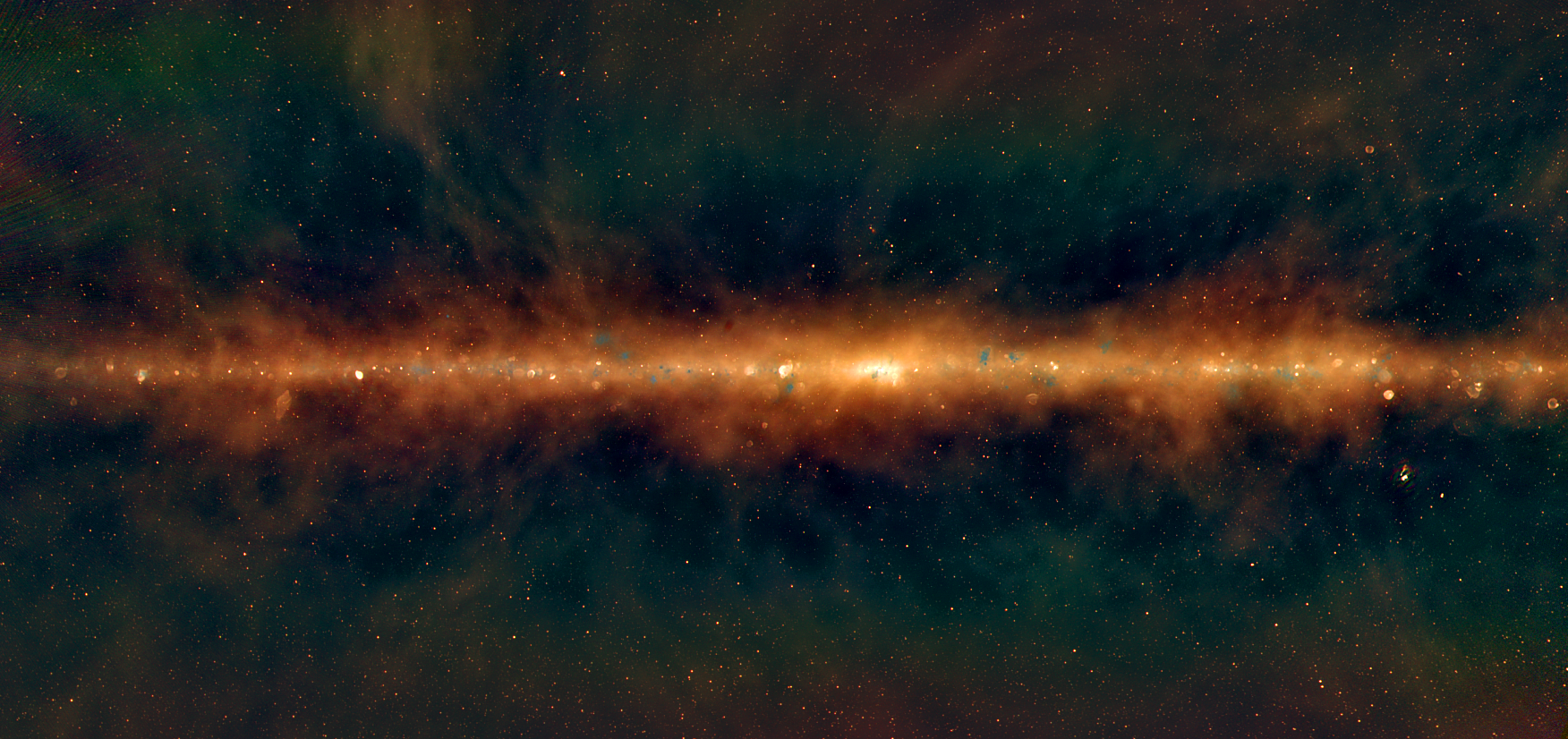
Radio image of the Galactic plane taken using the Murchison Widefield Array. Credit: Natasha Hurley-Walker (ICRAR), GLEAM
Background & Motivation
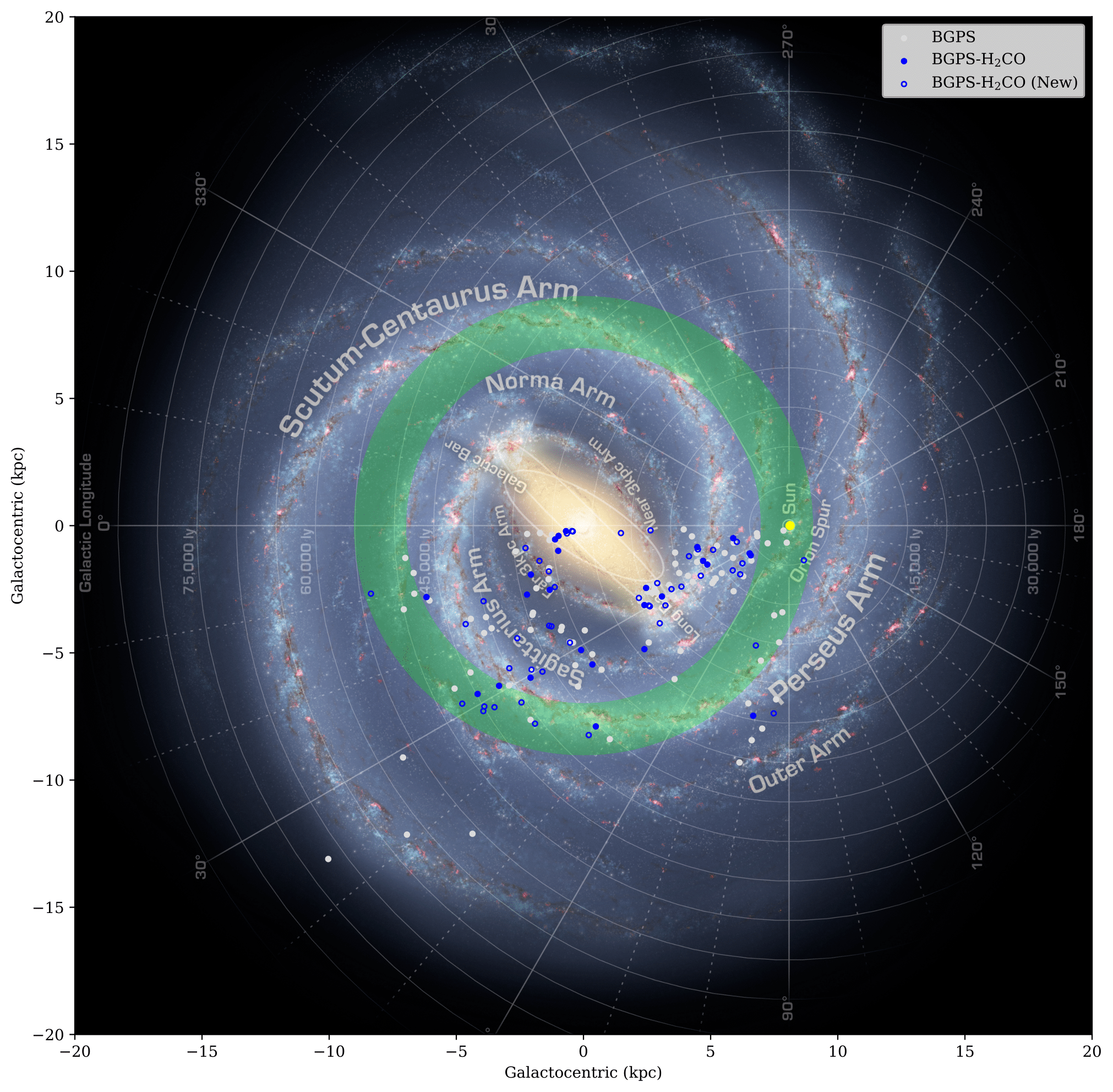
Formaldehyde (H2CO) is often referred to as a “biogenic precursor” because it plays a foundational role in the synthesis of complex organic molecules (COMs) necessary for life. Traditionally, models of the “Galactic Habitable Zone” (GHZ) have focused on physical parameters — such as the presence of heavy elements and a low risk of supernovae — suggesting that the most habitable regions of our galaxy are located in a narrow ring far from the chaotic Galactic Center (Gonzalez, 2001; Lineweaver et al., 2004). This project sought to challenge these models by mapping the actual chemical availability of H2CO across a vast range of environments in the Milky Way.
Methodology
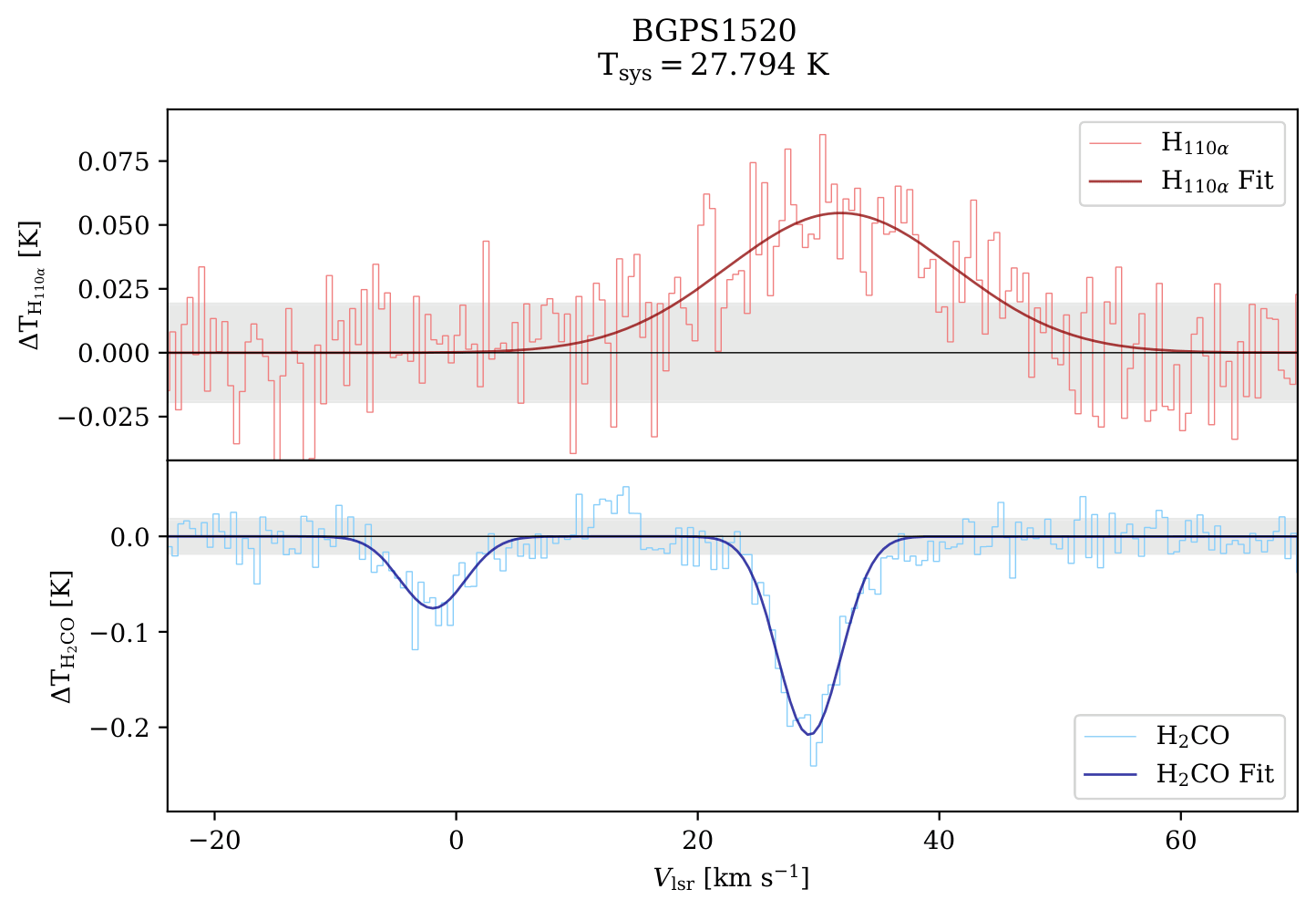
We conducted a comprehensive survey of 215 molecular clouds identified by the Bolocam Galactic Plane Survey (BGPS). Using the Nanshan 25m radio telescope, we observed H2CO absorption and radio recombination line (H110α) emission. By cross-matching our data with kinematic distance catalogs, we were able to trace the presence of these molecules across Galactocentric distances ranging from just 0.2 kpc to 10.8 kpc, covering almost the entire inner and local Galaxy.
H2CO and H110α spectrum of a BGPS source taken using the Nanshan 25m radio telescope
Key Findings
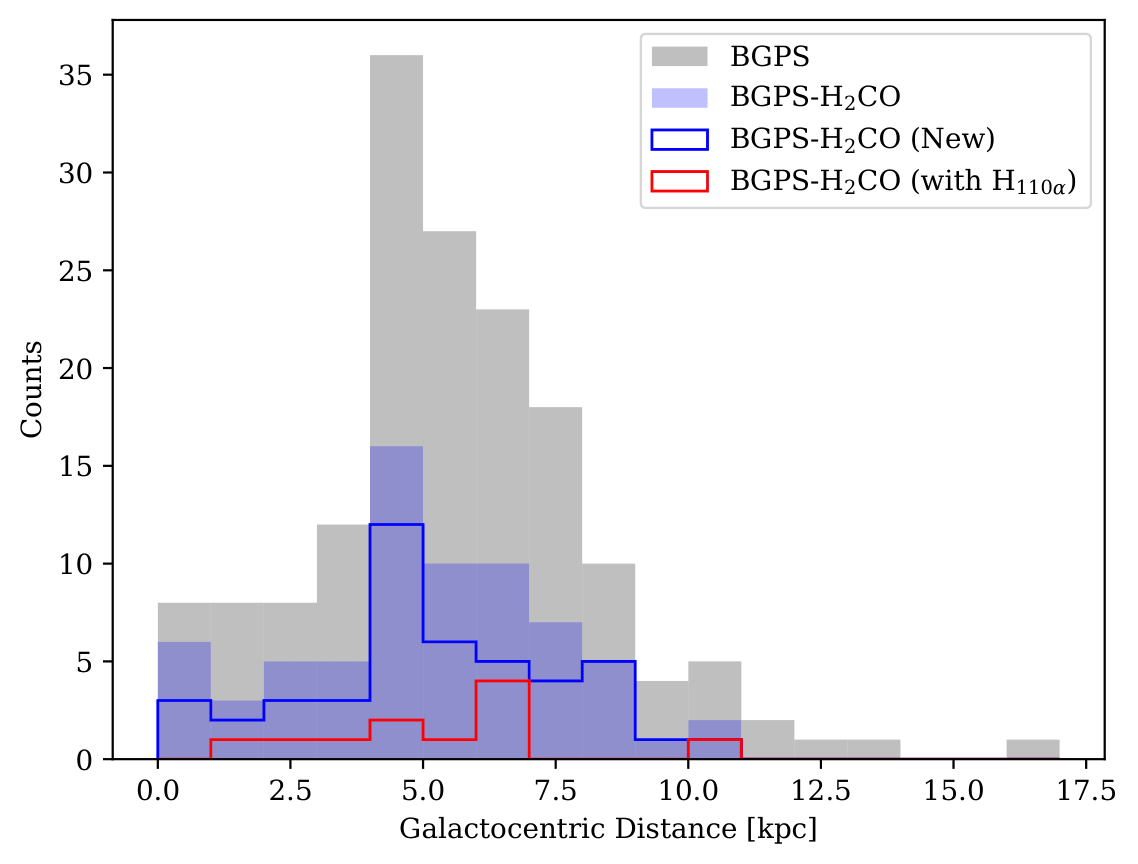
Our survey resulted in 88 detections of H2CO, 59 of which were entirely new. The most significant finding was a clear inverse correlation between the detection fraction of formaldehyde and its distance from the Galactic Center.
Distribution of galactocentric distances for all cross-matched BGPS sources (grey) and those with H2CO detections (blue)
Specifically, we found that biogenic precursors are not only present but are significantly more abundant toward the inner Galaxy (Baharin et al., 2025). This discovery suggests that the dense molecular clouds in these regions act as effective shields, protecting delicate chemical precursors from the intense radiation environment of the Galactic Center. This research indicates that the “chemical boundaries” of habitability are likely much broader than previously thought (Blair et al., 2008), requiring a more nuanced definition of the Galactic Habitable Zone that incorporates chemical tracers alongside physical constraints.
Face-on view of the Milky Way showing locations of H2CO detections in BGPS molecular clouds, with the green annulus marking the traditional GHZ definition
References
The Galactic Habitable Zone: Galactic
Chemical Evolution
We present a comprehensive study of formaldehyde (H2CO)
absorption and radio recombination line (H110α) emission in
215 molecular clouds from the Bolocam Galactic Plane Survey, observed
using the Nanshan 25 m radio telescope. H2CO was detected in
88 sources (40.93%) with 59 being new detections, while H110α
emission was found in only 11 sources (5.12%), all coincident with
H2CO absorption. There exists a correlation of
H2CO fluxes with millimeter fluxes below a \(3~\mathrm{Jy}\) threshold and an increased
dispersion above it, suggesting the sub-cosmic microwave background
cooling of H2CO. Cross-matching with kinematic distance
catalogs revealed H2CO spanning galactocentric distances from
\(0.216\) to \(10.769~\mathrm{kpc}\), with column
densities ranging from \(7.82 \times
10^{11}\) to \(6.69 \times
10^{14}~\mathrm{cm}^{-2}\). A significant inverse correlation was
observed between H2CO detection fraction and galactocentric
distance, suggesting enhanced star-forming activity closer to the
Galactic Center. These findings challenge traditional Galactic Habitable
Zone (GHZ) models by demonstrating the presence of biogenic precursors
in the inner Galaxy, shielded within dense molecular clouds. Our results
underscore the importance of incorporating chemical tracers such as
H2CO, alongside physical constraints to refine the boundaries
of the GHZ and advance the research of prebiotic chemistry in the Milky
Way.
@article{Baharin2025,title={Rethinking Habitability Using Biogenic Precursors: Formaldehyde in Millimeter Molecular Clouds of the Inner {Galaxy}},volume={988},issn={1538-4357},url={http://dx.doi.org/10.3847/1538-4357/add691},doi={10.3847/1538-4357/add691},number={1},journal={The Astrophysical Journal},publisher={American Astronomical Society},author={Baharin, Nursyazela Badrina and Nazri, Affan Adly and Rosli, Zulfazli and Abidin, Zamri Zainal and Tajuddin, Hairul Anuar and Esimbek, Jarken and Li, Da Lei and Tang, Xiaoke},year={2025},month=jul,pages={36},}
Formaldehyde in the Far Outer Galaxy:
Constraining the Outer Boundary of the
Galactic Habitable Zone
Samantha K. Blair, Loris Magnani, Jan Brand, and Jan G.A. Wouterloot