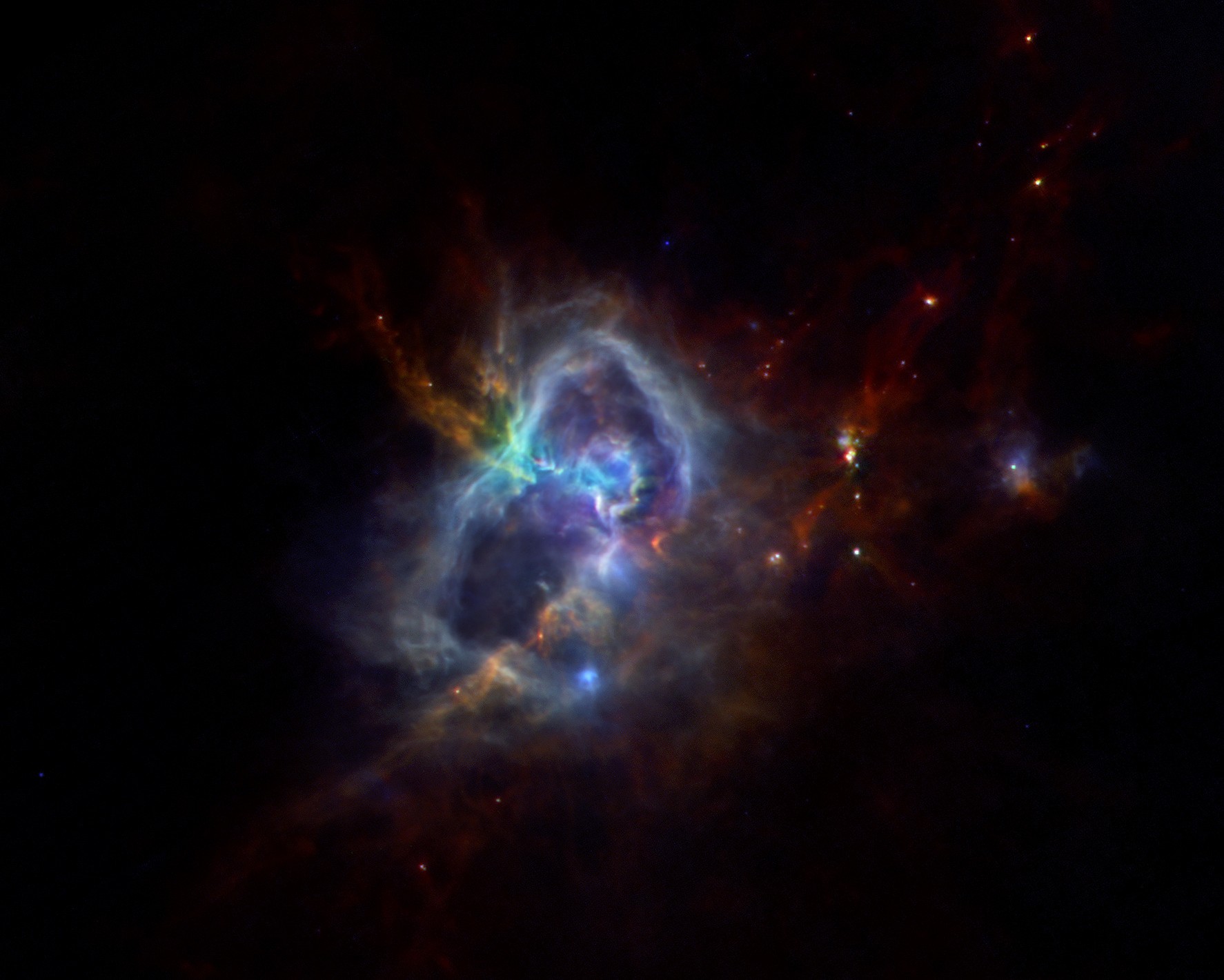
Infrared image of W40 taken using the Herschel Space Telescope. Credit: ESA, SPIRE & PACS, Ph. André (CEA Saclay)
Background and Motivation
How do massive stars shape their birthplaces, and what triggers the formation of the dense “hubs” where they reside? Studies have even constrained the hub-filament systems as the only source of high-mass stars (Kumar et al., 2020). To answer these questions, we targeted W40, a nearby high-mass star-forming region. W40 is characterized by a prominent bipolar HII region – a bubble of ionized gas — surrounded by a complex network of cold, dense filaments. Our goal was to map the kinematics of the gas within these filaments to understand how they funnel material into the central cluster and how the massive stars’ radiation, in turn, impacts the surrounding environment.
Methodology
We performed a multi-wavelength study using high-sensitivity molecular line observations, including tracers like C18O, H13CO+, and N2H+. These tracers allowed us to “see through” the dust and map the velocity of the gas.
Structural Identification: We identified six velocity-coherent filaments, four of which converge toward a central infrared-bright cluster. This cluster hosts the region’s most massive star, IRS 1A South (an O9.5V star), which provides the primary ionizing radiation for the W40 complex.
Filaments in W40 identified using H13CO+ emission
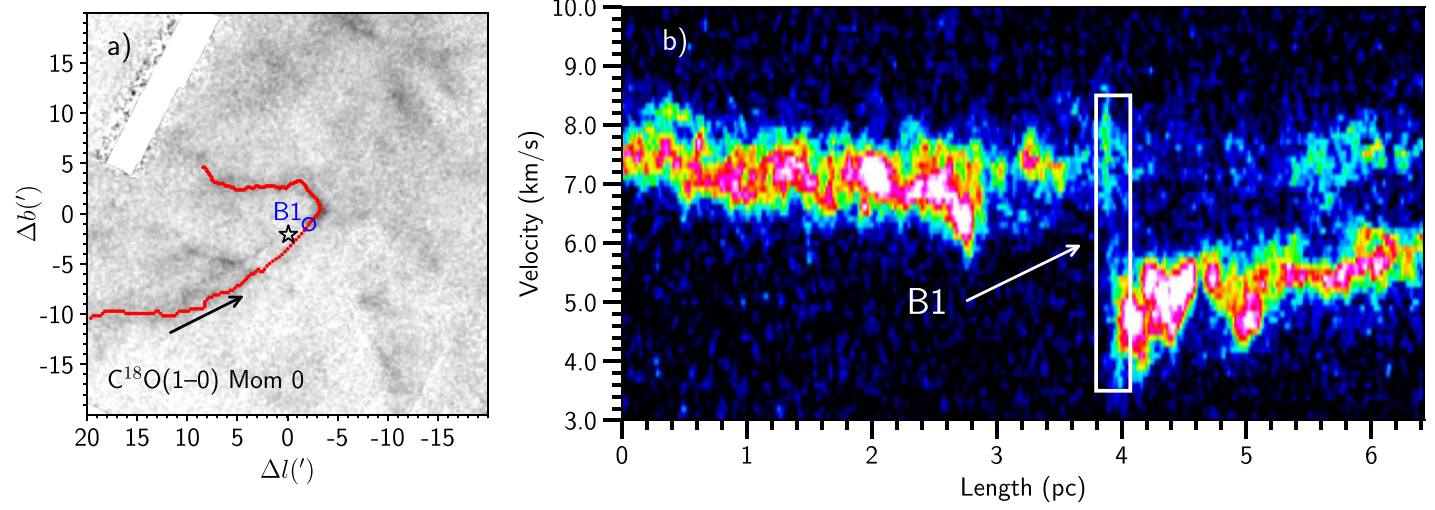
Kinematic Signatures: By analyzing the gas velocities, we detected a “bridge-like” feature in position-velocity space. This is a tell-tale signature of two separate molecular clouds interacting.
Position-velocity diagram of C18O emission in W40 showing the bridge-like feature
Key Findings
The results suggest that the massive star cluster at the center of W40 was not formed in isolation but was likely triggered by a cloud-cloud collision (Lim et al., 2025). The collision between two gas flows — moving at different velocities — created the dense hub-filament structure necessary to ignite high-mass star formation.
Furthermore, we found evidence that the stellar feedback is not just destructive; it is actively shaping a new generation of stars. Specifically:
Secondary Star Formation: Along the “waist” of the bipolar bubble, we detected clumpy emission from C2H and infrared “elephant trunk” features. These indicate that the pressure from the expanding ionized gas is compressing nearby dense gas, potentially triggering a newer episode of star formation.
Turbulence Dissipation: We observed that while the large-scale filaments exhibit supersonic motions, the smaller, dense clumps within them show subsonic turbulence. This suggests that as gas moves from the filaments into the clumps, the energy is dissipated, allowing the gas to collapse and form new stars.
References
Unifying low- and high-mass star formation through density-amplified
hubs of filaments: The highest mass stars (\(> 100~\mathrm{M}_{\odot}\)) form only in
hubs
M. S. N. Kumar, P. Palmeirim, D. Arzoumanian, and S. I. Inutsuka
The FIRESTORM project — Feedback-Induced Regions and Emission from
Star-forming Tracers of ObseRvable Molecular Gas — has targeted four
star-forming regions to quantify the impact of stellar feedback on star
formation. In this paper, we present multiwavelength results for one of
the targets, the nearby high-mass star-forming region W40. Using
dense-gas tracers C18O(1-0) and
H13CO+(1-0), we identified six velocity-coherent
filaments: five at \(V_{LSR} \sim
7.5~\mathrm{km}~\mathrm{s}^{-1}\) and one at \(V_{LSR} \sim
5~\mathrm{km}~\mathrm{s}^{-1}\). Four of these converge towards
an infrared-bright cluster hosting the most massive star of the region
(IRS 1A South, O9.5V), forming a hub-filament system (HFS). Key physical
parameters, including filament lengths, widths, masses, velocity
dispersions, and line masses, are derived. Five dense clumps traced by
N2H+(1-0) exhibit subsonic to transonic
turbulence, contrasting with the supersonic motions of their parental
filaments, indicating turbulence dissipation. A deficit of emission at
\(V_{LSR} \sim
7~\mathrm{km}~\mathrm{s}^{-1}\) in several molecular lines, along
with a blueshifted absorption dip in the HCN(1-0) profile, suggests that
emission from OB-heated gas is being absorbed by a cold foreground
cloud. A bridge-like feature in position-velocity space connects the
\(\sim 5~\mathrm{km}~\mathrm{s}^{-1}\)
and \(7.5~\mathrm{km}~\mathrm{s}^{-1}\)
filaments, and spatially coinciding with dense condensations and radio
continuum peaks. These findings suggest that a past interaction — likely
a cloud-cloud collision — triggered the formation of HFS and ultimately
the central massive cluster.
@article{Lim2025,title={{FIRESTORM I}: {Stellar} feedback and gas kinematics in the evolved {W40} hub-filament system},volume={545},issn={1365-2966},url={http://dx.doi.org/10.1093/mnras/staf2218},doi={10.1093/mnras/staf2218},number={4},journal={Monthly Notices of the Royal Astronomical Society},publisher={Oxford University Press (OUP)},author={Lim, Ming-Kang and Yadav, Ram K. and Dewangan, L. K. and Kim, Kee-Tae and Zavagno, A. and Maklai, Jedsada and Schneider, Nicola and Arzoumanian, Doris and Jacob, Arshia M. and Pirogov, L. E. and Hwang, Jihye and Ojha, D. K. and Lee, Gyuho and Nazri, Affan Adly and Sharma, Saurabh},year={2025},month=dec,}