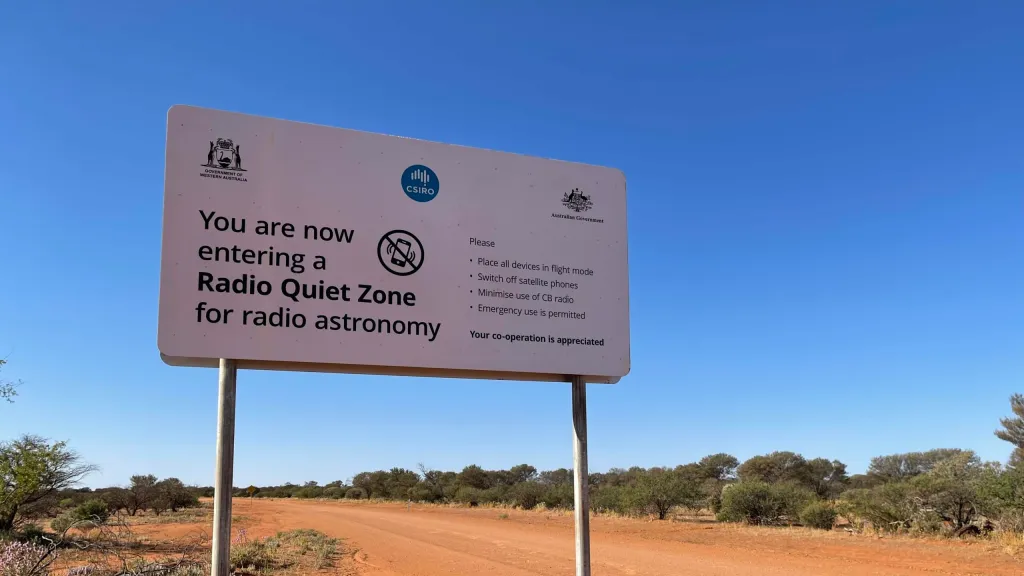
Radio Quiet Zone boundary marker in Western Australia. Credit: CSIRO
Background and Motivation
While Malaysia holds significant potential for radio astronomy due to its strategic equatorial location and its role as a vital link for regional VLBI networks (like SEAVN), its high population density presents a major challenge in the form of terrestrial radio frequency interference (RFI). Traditional RFI studies in the region often suffered from limitations such as large time cadences and a lack of statistical evaluation, which made it difficult to detect transient signals. This study aimed to overcome these hurdles by performing high-cadence monitoring to characterise both persistent and transient RFI at a candidate Radio Notification Zone (RNZ).
Methodology
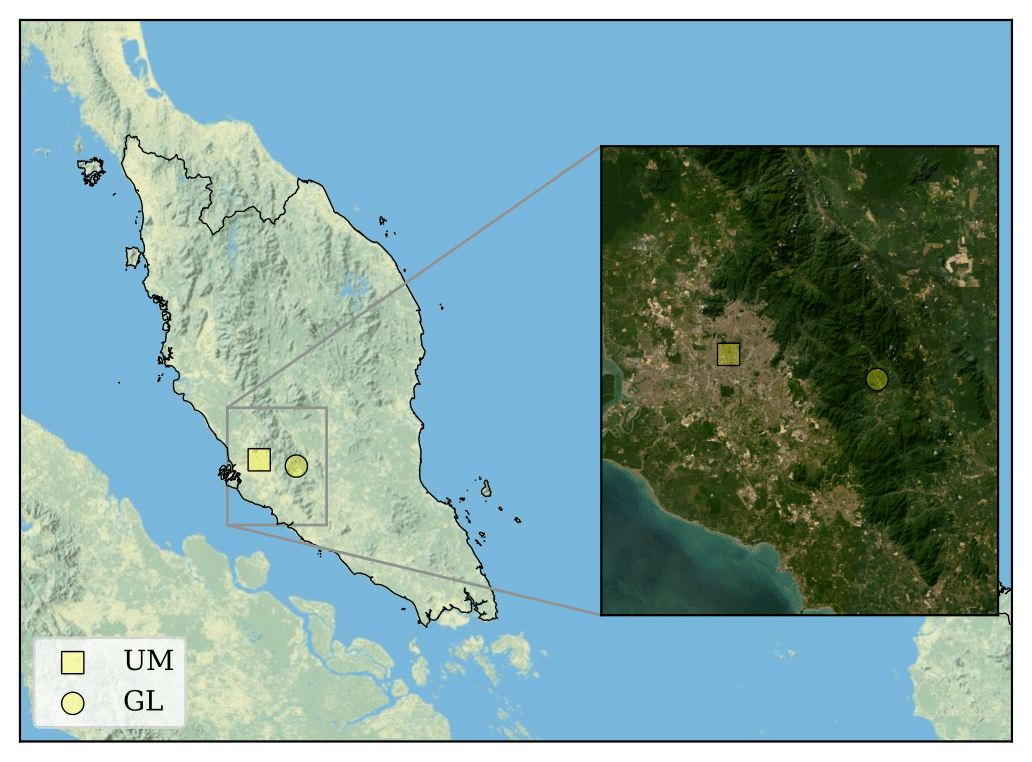
We conducted a comparative study between two distinct environments: an urban site at Universiti Malaya (UM) in Kuala Lumpur and a rural site at the Glami Lemi Biotechnology Research Centre (GL) in Jelebu, which was previously highlighted as a candidate RNZ candidate (Abidin et al., 2021). Observations utilised a dual-polarization logarithmic periodic antenna paired with a Liquid Instruments Moku:Lab configured as a spectrum analyser with a 0.3~second cadence.
RFI measurement locations (UM: Universiti Malaya, GL: Glami Lemi)
Key Findings
The analysis revealed a stark contrast between the two environments, confirming the rural site’s promise for future astronomical observations (Nazri et al., 2025):
Urban vs. Rural Contamination: The urban site (UM) was almost entirely unusable, with 99.90% of frequency channels flagged for RFI. In contrast, the rural site (GL) had significantly lower contamination, with only 45.85% of channels flagged.
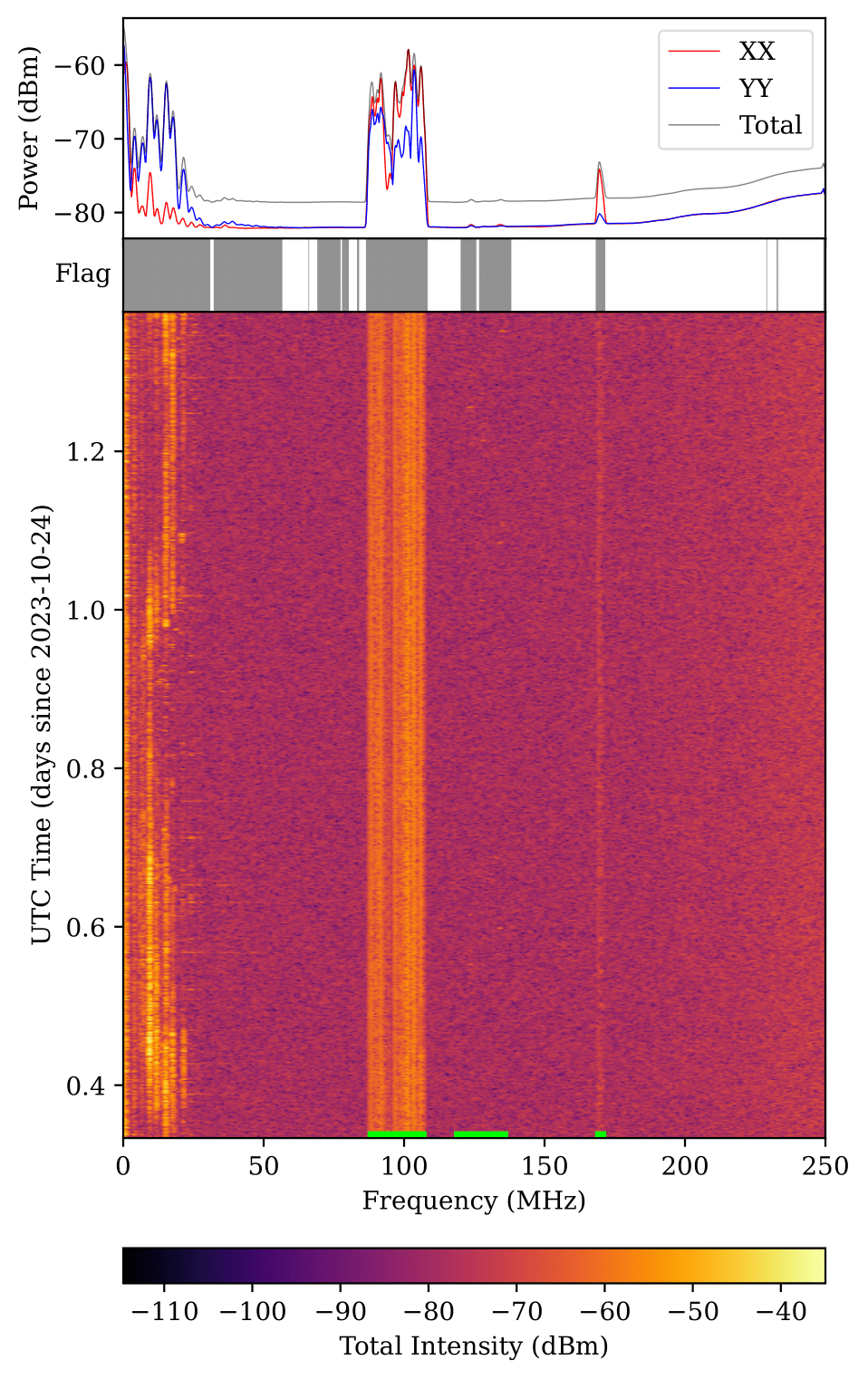
Persistent RFI: Three major persistent signals were identified at the rural site, including FM radio broadcasts (87–108 MHz) and government mobile services (162–174 MHz).
Ionospheric Effects: A clear diurnal pattern in low-frequency signals (below 35 MHz) was observed, where the peak frequency of the interference correlated with solar altitude. This “skywave” phenomenon demonstrates how ionospheric layers reflect distant radio signals more effectively during the day.
The significantly lower baseline noise and lower detection of RFI at Glami Lemi support its designation as a viable RNZ and a strong candidate for future radio telescope development in Malaysia.
RFI spectrum and GSK flagging results for Glami Lemi data
References
Radio quiet and radio notification zones characteristics for radio astronomy in medium densely populated areas and humid tropical countries
Zamri Z. Abidin, Zulfazli Rosli, Mohd S. M. Radzi, Noraisyah M. Shah, Mahidzal Dahari, ...
Journal of Astronomical Telescopes, Instruments, and Systems, 7(02), Apr 2021
Extensive radio frequency interference (RFI) monitoring is essential in the site selection process before constructing radio astronomy observatories, followed by mitigation strategies to minimize its adverse effects. Malaysia has an enormous prospect for radio astronomy due to its prominent location in the centre of Southeast Asia, but is challenged by its relatively high population density. In this research article, we perform high-cadence, low-frequency RFI monitoring at two sites, each representing an urban and a rural environment. Using modified generalized spectral kurtosis (GSK) as an RFI detection method, we ascertain the suitability of Glami Lemi, a rural area in the centre of Peninsular Malaysia previously assigned as a candidate radio notification zone (RNZ), as a potential site for radio astronomy observations due to its lower RFI contamination in our high-cadence monitoring, especially when compared with urban areas. We identified a number of persistent and transient RFI in our dataset, associate each of them with their potential origins and, if present, characterize their temporal evolution. A few types of RFI mitigation strategies were also tested and discussed. This study lays the groundwork for Malaysia's endeavours in establishing its first research-grade radio telescope, emphasizing the importance of robust RFI detection and mitigation strategies in optimizing observational outcomes.
@article{Nazri2025,title={Temporal variability in low-frequency radio interference: Insight from high-cadence monitoring at a candidate radio notification zone in {Malaysia}},issn={0273-1177},url={http://dx.doi.org/10.1016/j.asr.2025.05.035},doi={10.1016/j.asr.2025.05.035},journal={Advances in Space Research},publisher={Elsevier BV},author={Nazri, Affan Adly and Abidin, Zamri Zainal and Mat Sabri, Mohamad Ridhauddin and Rosli, Zulfazli and Hassan, Mohd Shaiful Rizal and Mohd Radzi, Mohd Shazwan and Zulkiplee, Ahmad Najwan and Hanim Razak, Dalilah Nur Fathiah and Asmi, Norsyazwani and Ping, Jinsong and Wang, Mingyuan and Dong, Liang},year={2025},month=may,volume={76},number={3},pages={1832--1853},}