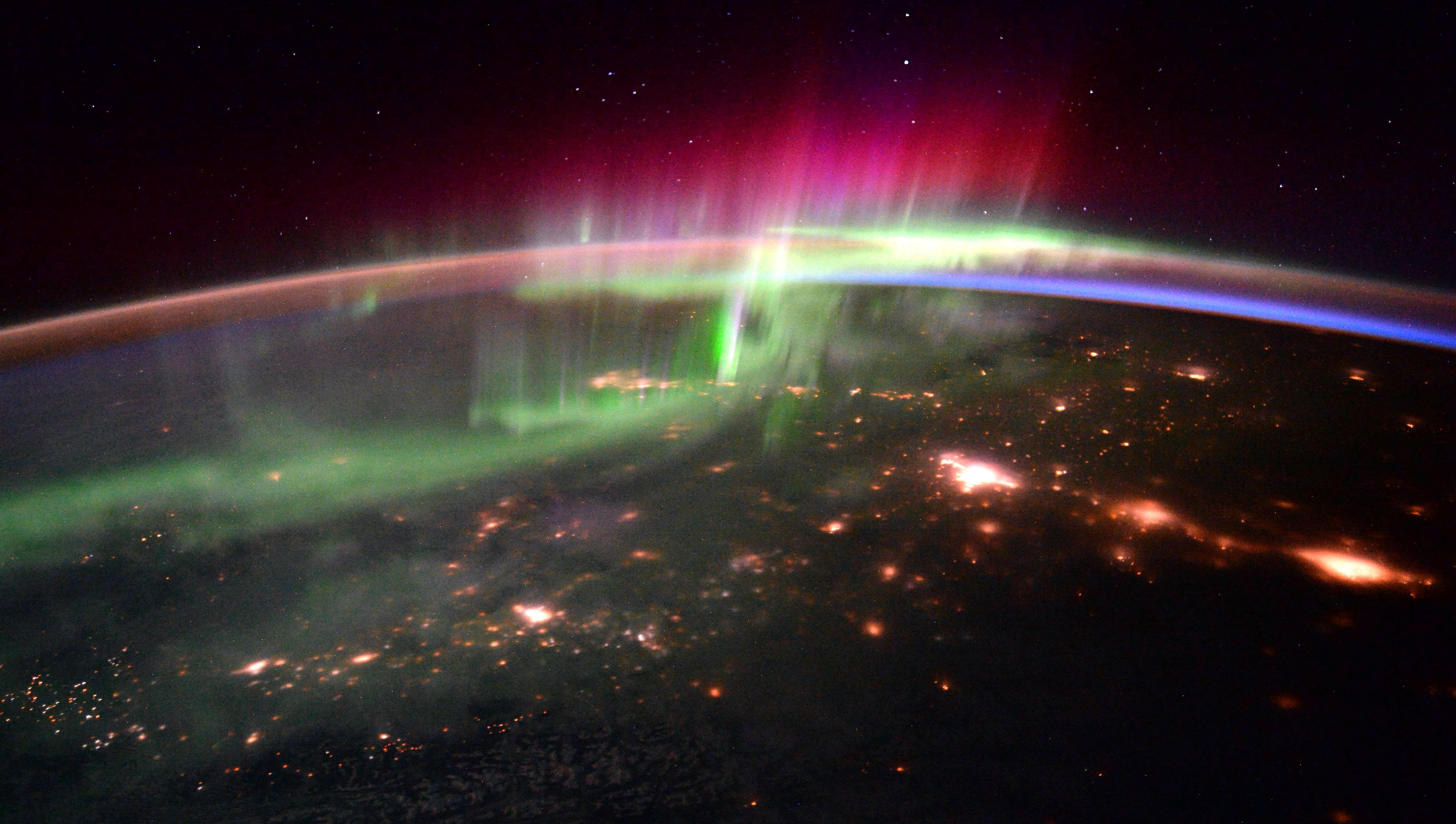
Aurora Borealis over Northern Canada as seen from the International Space Station. Credit: ESA/NASA
Background and Motivation
The Earth’s ionosphere is a dynamic region of the upper atmosphere that is heavily influenced by solar activity. Variations in solar radiation and solar wind can lead to changes in the ionospheric electron density, which in turn affects radio wave propagation and can cause disruptions in communication and navigation systems. This project investigates the variability of global vertical total electron content (VTEC) in response to solar and geomagnetic drivers across three solar cycles (23 to 25). It aims to bridge gaps in understanding how these relationships and their associated time-lags change across distinct solar cycle phases.
Methodology
We compared VTEC data from the Global VTEC maps provided by the Chinese Academy of Sciences (Li et al., 2021) with solar and geomagnetic data from NASA’s OMNIWeb database (King & Papitashvili, 2005). We analyzed the correlations between VTEC and various solar and geomagnetic indices, such as the F10.7 solar flux, sunspot number, and Kp index, across different phases of the solar cycle (rising, maximum, declining, and minimum). We also investigated the time-lags between changes in solar activity and corresponding responses in VTEC to understand the temporal dynamics of these relationships.
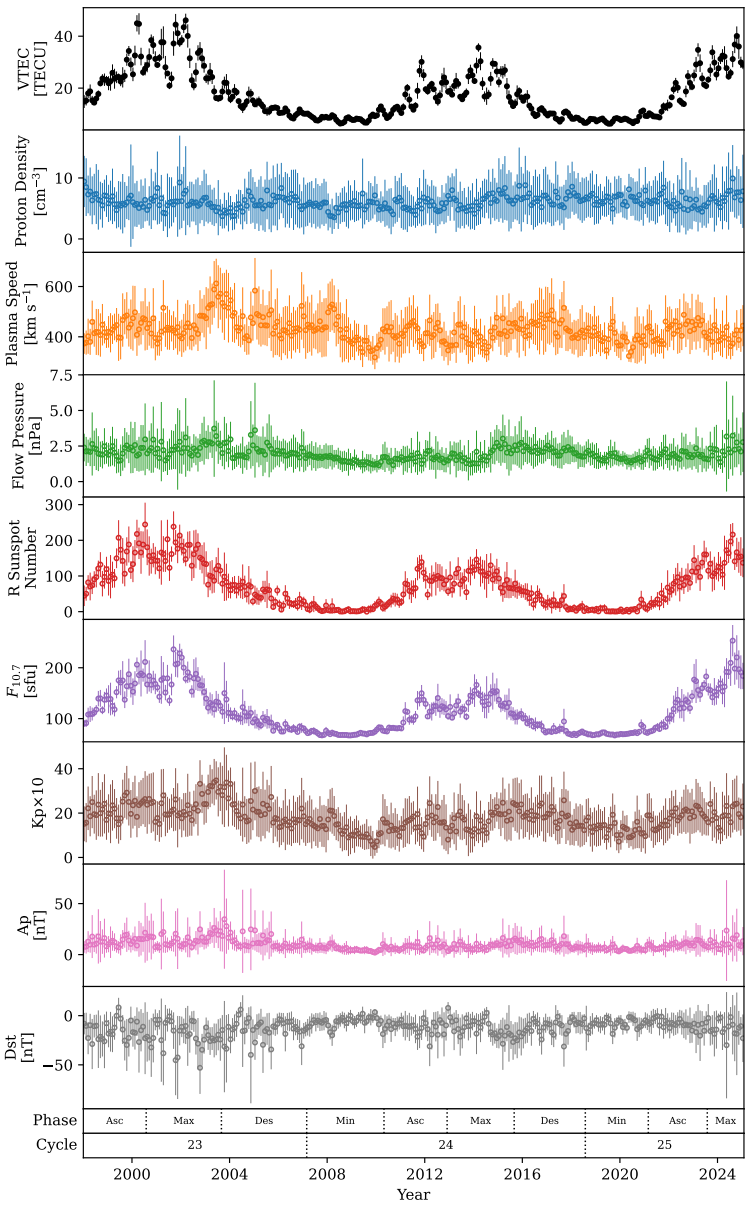
Global VTEC average and OMNIWeb solar, geomagnetic, and solar wind parameters from 1998 to 2025.
Key Findings
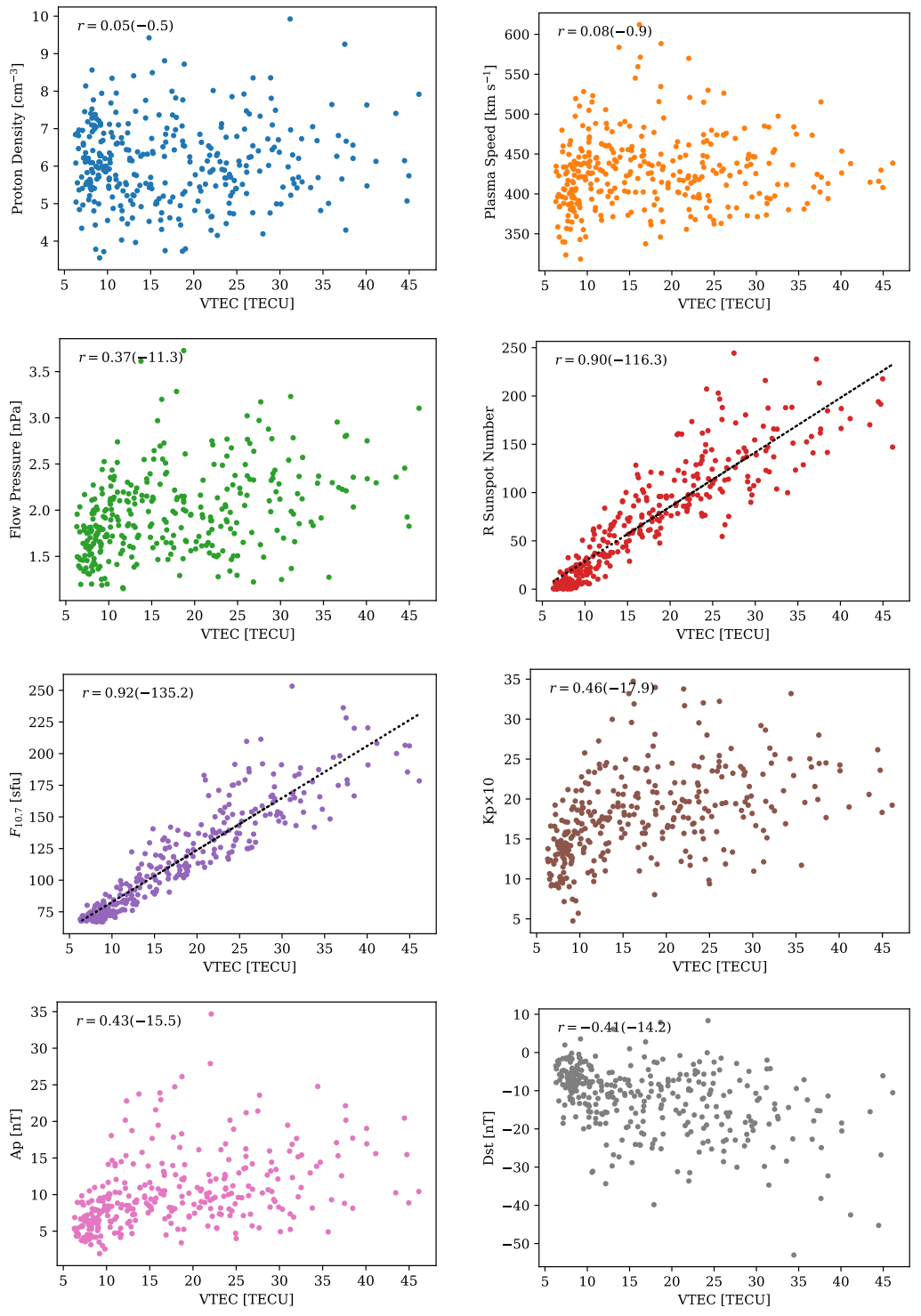
Our analysis revealed that the correlation between VTEC and solar proxies are strongest and most consistent, primarily during the ascending and descending phases of the solar cycle (Hassan et al., 2026). During solar maximum, the correlations weaken due to disruptions from solar transients, while VTEC becomes more susceptible to non-solar factors during solar minimum. We also observed that geomagnetic indices show moderate correlations and solar wind parameters exhibit weak to no direct global correlation. A characteristic 2-day lag was observed between solar activity and VTEC response, atttributed to thermospheric oxygen dynamics and ionospheric chemistry.
Correlation between VTEC and solar, geomagnetic, and solar wind parameters.
References
Status of CAS global ionospheric maps after the maximum
of solar cycle 24
This study examines the variability of ionospheric total electron
content (VTEC) in response to solar and geomagnetic drivers across solar
cycles 23 to 25. While the dominant effect of solar radiation on VTEC is
well-known, a comprehensive understanding of how these relationships and
their time-lags vary across distinct solar cycle phases and across
cycles of differing intensity has been lacking. Using global VTEC data
from the Chinese Academy of Sciences Global Ionospheric Maps (CASG) and
solar-geophysical indices from NASA’s OMNI dataset spanning from 1998 to
2025, this study bridges that gap by quantifying correlation strengths
and time-lag relationships between VTEC and parameters such as \(F_{10.7}\) solar flux, R sunspot number,
Kp, Ap, and Dst indices, and solar wind properties. Results show that
solar proxies, particularly \(F_{10.7}\) and R sunspot number, exhibit
the strongest, most consistent correlations with VTEC, especially during
the ascending and descending phases of the solar cycle, with a
characteristic \(\sim 2\)-day lag
attributed to thermospheric oxygen dynamics and ionospheric
recombination processes. In contrast, geomagnetic indices exhibit weaker
and phase-dependent correlations, while direct correlations between
solar wind parameters and global VTEC are weak, as their influence is
primarily mediated by geomagnetic activity and exhibits strong regional
and temporal heterogeneity. Phase-resolved analyses further reveal that
geomagnetic activity plays a more prominent role during transitional
phases, while maximum and minimum periods are dominated by EUV
variability and non-solar drivers, respectively. These findings
highlight the necessity of incorporating solar phase and time-lag
dependencies in ionospheric modelling and forecasting efforts.
@article{Hassan2026,title={Investigating Ionospheric {TEC} Variations in Solar and Geomagnetic Influences Across Solar Activity Phases},issn={0273-1177},url={http://dx.doi.org/10.1016/j.asr.2026.02.030},doi={10.1016/j.asr.2026.02.030},journal={Advances in Space Research},publisher={Elsevier BV},author={Hassan, Ziyadat and Abidin, Zamri Zainal and Nazri, Affan Adly and Baharin, Nursyazela Badrina},year={2026},month=feb,}